
Rethinking audit—Part 4: What value can audit bring?
Businesses today are operating in a rapidly changing landscape—one that’s broadening the needs of stakeholders when it comes to independent assurance. We’ve partnered with Jo Rhoden, an independent consultant in strategy, design, and innovation, with a focus on the future of professional services. Drawing on her wealth of audit expertise, Jo’s blog series will explore an important question for firms: Is it time to rethink the purpose and scope of the external audit?
The series will examine:
- Who values audit?
- Why is audit important?
- How will audit delivery change?
- What value can audit bring?
Part 4: What outcomes and value can external audit deliver?
So far in this series, we have talked about who the stakeholders of audit are, and how they are broadening. We have discussed why the external audit is important, enabling trust and decision making in an increasingly challenging and uncertain business and economic environment. We have explored how an audit can be reimagined, harnessing the ever-increasing power and capacity of advanced technology.
What direction should all these changes, choices, and opportunities take us in? What kinds of outcomes and value can external auditors deliver in the long term?
The importance of creative thinking
To imagine, and then to design and build this, we need to think differently. Traditionally, audit and accounting have valued critical and analytical thinking. According to the WEF, these attributes will continue to be at the top of the list of needed skills into 2030. However, I believe we need some different ways of thinking and working to shape a better future.
Rather than breaking down and breaking apart—the kind of thinking to which that analytical mindset is so suited—we need to imagine, envision, and synthesise. For this, creative skills and thinking (number four on the WEF “skills on the rise” list1) are essential.
Creativity has historically had negative connotations in the world of accounting. It is also increasingly hidden in terms such as flexibility or resilience across the business world. Let’s be clear, however. To live in a better future, we need to make it. Creativity will play the crucial part here, from envisioning the future to developing the skills, processes, and methods to build it. Combining all different ways of thinking will enable a better outcome.
This article in Forbes2 explains how creativity is increasingly needed in our AI landscape:
“Coming up with new ways of doing things, solving problems in an imaginative way, and imagining how things could be changed for the better. These will all be important to many jobs in 2030 as it’s unlikely they will be taken on by AI. As the pace of change—driven by digital transformation—accelerates, businesses and organisations are likely to find themselves thrown into new and unfamiliar situations with growing frequency. This means that those who are able to think ‘outside of the box’ will be necessary for developing innovative solutions as challenges arise.”
A model for designing the future of audit
Going back to my earlier article on why external audit is important, a core premise is the provision of trust—trust in the story that the corporate entity is telling. This will be increasingly important as the demands of stakeholders and calls for consistency and clarity around both what is reported and how it is reported continue to intensify. Global uncertainty provides the opportunity for auditors to cut through the murkiness with clarity and independence.
With this in mind, I propose a prototype model for discussing and designing what the future of audit can become. It is framed as a continuum from certainty to uncertainty with the leading edge being the newly unfolding areas of reporting as it is envisioned and evolves. I also propose some design questions that can be considered and used to provoke discussion when thinking about what the future of the profession could be.
Please note, as a prototype, there are gaps, assumptions, and provocations. The model is not intended as a definitive design. We welcome your ideas, challenges, and improvements.
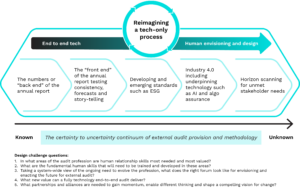
Rethinking the future of audit
Auditors enable trust in the financial and business ecosystem. There is ongoing need for the provision of trust, and the scope of trust is broadening as stakeholders continue to demand more in terms of transparency and accountability.
The work of auditors will increasingly be taken on by growing capability in AI systems. However, the need for creative thinking in combination with analytical and critical thinking will remain in order to envision, design, and then deliver the future of the trusted audit to meet the as yet unmet needs of stakeholders.
In this murky landscape, the value of the human auditor can really shine. But it requires understanding of the needs of the broader stakeholders in the ecosystem and developing, alongside regulators and standard-setters, new policy and processes to create the highly valued profession of the future.
About Jo
Jo Rhoden is a Fellow of the Institute of Chartered Accountants in England and Wales. She began her career in London in audit and consulting before moving to Sydney, where she focused on fast-growing technology and biotechnology companies, including audit and due diligence for venture capital firms. Moving to a Big Four firm, she helped transform the audit process by integrating innovation, data, digital, and design techniques, building a team of “audit designers” to enhance client experiences and later leading this work globally through a client experience programme. Jo also led brand strategy and developed a Global Audit Committee programme addressing major market-facing issues. She currently serves as Chair of the Audit and Risk Assurance Committee at the University of Bath and works as an independent consultant in strategy, design, and innovation, with a focus on the future of professional services.
Source’s audit research
Learn more about Source’s research into the future of audit here, or contact us.
[1] The Future of Jobs Report 2025 | World Economic Forum
[2] https://www.forbes.com/sites/bernardmarr/2023/02/14/the-top-10-in-demand-skills-for-2030/